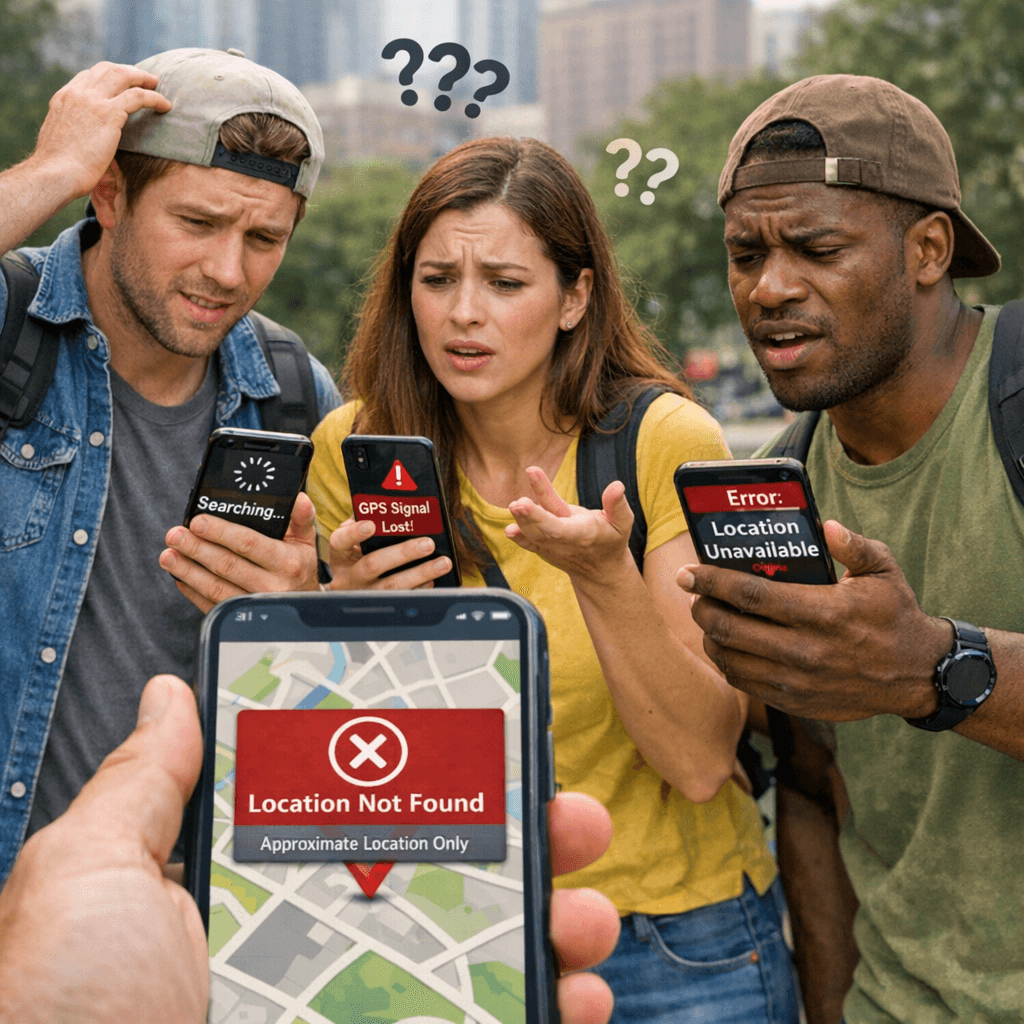
Location sharing can be super useful. Finding your friend when meeting up in a busy city, keeping track of loved ones or using Google Maps to explore somewhere new. But sometimes, it's not reliable. Sometimes, it's a bit off... or wildly off!
Let's explore some reasons as to why your location is hard to pin point...
1. Weak or Obstructed GPS Signal
GPS works best when your device has a clear view of the sky. When you’re indoors, underground, or surrounded by tall buildings (often called “urban canyons”), signals can bounce off surfaces or get blocked entirely. This interference reduces accuracy and can cause your location to jump or appear incorrectly.
2. Reliance on Wi-Fi or Mobile Networks
When GPS isn’t available, or is turned off, devices fall back on Wi-Fi networks and mobile towers to estimate location. While this is useful, it’s far less precise. In cities, this might only be slightly off, but in rural areas, it can place someone hundreds of meters away from their actual location.
3. Device Settings and Permissions
Sometimes the issue comes down to settings. Many modern smartphones allow users to choose between “precise” and “approximate” location sharing. If precise location is turned off, accuracy drops significantly. Other factors include:
- Location services being turned off entirely
- App permissions being restricted
- Battery-saving modes limiting background updates
4. Poor Internet Connection
Some apps rely on an internet connection to refine location data. If the signal is weak or unstable, location updates can be delayed or outdated, making it seem like someone hasn’t moved—or is somewhere they’re not.
5. Outdated or Paused Location Updates
Not all apps update location in real time. Some refresh periodically, which can create a lag. If the app is closed or running in the background, the device’s operating system may also limit how often it updates location to save battery.
6. GPS Drift and Calibration Issues
Even when a device is stationary, GPS can sometimes “drift,” causing small movements on the map. This is usually minor but can be confusing. Calibration issues with the device’s compass or sensors can make this worse.
Certain tools can interfere with or deliberately change location data:
- VPNs can affect IP-based location estimates
- Spoofing apps can intentionally fake a device’s location
This means the location shown may not reflect where the person actually is.
8. Device Hardware Differences
Not all devices are created equal. Older or lower-cost phones may have less accurate GPS hardware. Differences in antenna quality and how devices combine data (GPS, Wi-Fi, and motion sensors) can all impact accuracy.
9. Environmental Interference
While weather doesn’t usually have a major effect, certain environments can. Large metal structures, vehicles, or other sources of interference can disrupt signals and reduce accuracy.
Have a look through these potential issues to optimise your location sharing - unless you don't want to be found!
Talk to us about a client
Call 01765 824971 or send us a message. We'll send you our assessment quote and the CV of the consultant who would carry out the assessment.