For case managers
Assistive technology that moves your client's rehab goals forward
Assistive technology is all we do.
You coordinate your client's rehabilitation. We're the assistive technology specialists in that plan. We link every recommendation to your client's goals, set it up where they live and learn, and train the support package you've put in place, so it's still being used months from now.
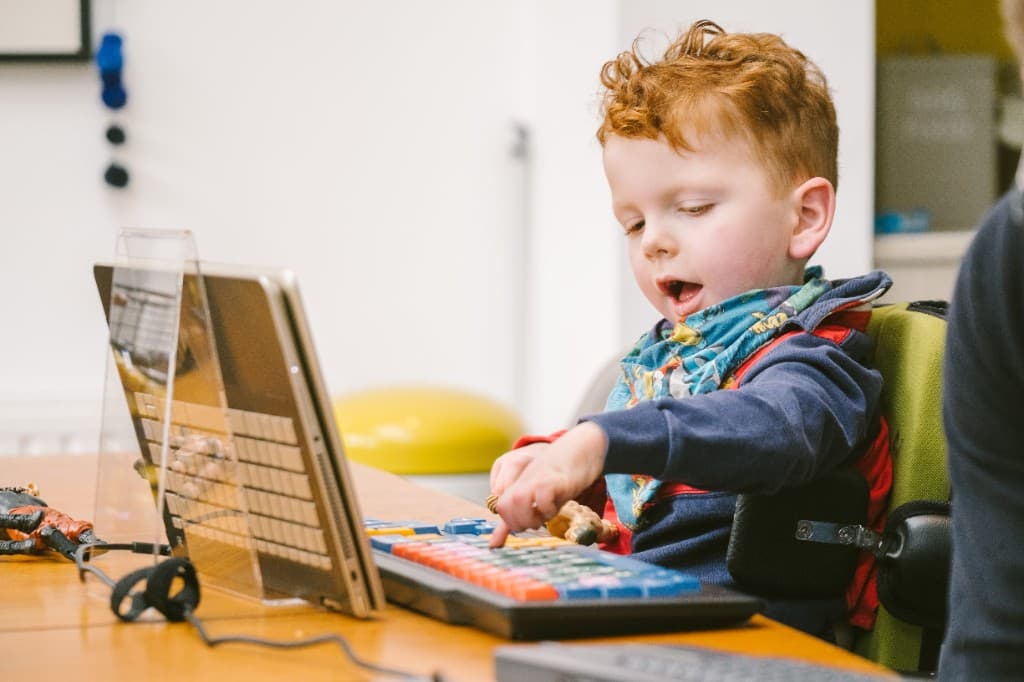
Built around your client's goals
Technology is a tool. Quality of life is the aim. Every recommendation is linked to your client's rehabilitation goals, whether that's communicating, controlling things at home, learning, working, enjoying their free time or staying safe online, and we report on what your client can now do.
Making it work day to day
Technology that works in a clinic can fail at home or in the classroom. We assess in the places your client lives and learns, and work alongside the support package you've put in place. Their buy-in is essential, so we train them until they understand the set-up and how it serves your client's rehab goals. That way the equipment is still being used, and still helping, after we leave.
- Set-up and training for your client, their family and their support workers.
- New support workers trained. When the support team changes, training has to be repeated. We build that in.
- Staying safe online. A brain injury can leave someone open to scams, overspending and exploitation online. Our digital wellbeing work helps your client and their team manage those risks.
Working with the MDT
We're the assistive technology specialists in your client's team. We work alongside speech and language therapists, occupational therapists, physios and psychologists, so the technology supports the goals everyone is working on. We come to MDT meetings too.
Rehab gains that keep going
Your client's rehabilitation happens every day, not only when a therapist or consultant is in the room. Once the support team can run and adapt the set-up, the technology keeps working towards the goals the MDT has set, between our visits and after we step back. We aim to make ourselves unnecessary for the day to day, and we're on hand when goals, equipment or the team change.
We drive the next step
We keep everyone in your client's team up to date with our plans, and we move things on ourselves. You won't need to phone us to find out what happens next.
If we see something that affects your client's safety, wellbeing or ability to make a decision, such as risks online, we raise it with you promptly and agree next steps with the team.
Reports you can act on
- Clear, costed recommendations, with set-up, training and support time included, ready to share with the MDT and pass to the deputy or funder for approval.
- Update reports that show what has changed for your client and what they need next.
Less chasing for you
- A quick reply. We aim to respond to all enquiries within 24 hours.
- We book the visit. Your consultant contacts the family or your client directly to arrange the assessment.
- We can handle the buying. Once costs are approved, we buy the equipment and set it up, so you're not chasing suppliers.
- We stay involved. Children grow, people move home, needs change at transitions and equipment wears out. Recurring support is an Annual Support Package. We review and adapt the set-up, including repairs and replacements, through settlement and beyond.
What's changed for clients
These are real cases. We've removed names and identifying details.
1. From hand-under-hand support to talking with classmates
A young child at a special school, with complex physical and communication needs, was just starting on a communication aid. At first they explored it only with an adult's hand guiding theirs. Working jointly with their speech and language therapist, we set up switch access, then trialled a keyguard and settings that made their choices more accurate. About a year and a half later, the MDT reported that they were using a wide range of vocabulary in every setting, and communicating spontaneously with classmates for the first time.
2. More control at home, year on year
At our first visit, a child with cerebral palsy and a visual impairment had very little they could play with independently. Over three years, working with their OT, speech and language therapist and physio, we added switch-adapted toys, a night-time switch and smart display so the family could check on them without waking them, and switch mounting on their bed. Three years on, they were reliably using a hand switch on one side and a head switch on the other. We're now planning switch control of lights, blinds and outdoor features in their new home with the wider team.
3. Growing independence after a brain injury
A young adult with an acquired brain injury, at college, worked through a digital wellbeing programme with us alongside their support team. We cut their phone set-up down to fewer steps, moved their timetable onto the calendar on their phone (their choice over paper), and practised spotting scam emails and fake websites. Their MDT has since reported growing independence in daily life, and they now manage their own technology, with us on hand when something changes.
Assessment, cost and timing
One in-person assessment, at home, school or both, followed by a written report.
Cost. We send you a quote for the assessment and report before anything is booked.
How long it takes. Our current lead time for an initial assessment is 12 to 16 weeks.
Questions about funding or approval? See our page for deputies and solicitors.
How to refer
- Get in touch. Call 01765 824971, email domore@accesstechnology.co.uk or use our contact form.
- Information. Please let us know your client's current litigation status and their location.
- Quote and CV. We send you our assessment quote and the CV of the consultant who will carry out the assessment.
- Referral form. Once you're happy to go ahead, you complete our referral form. Please send clinical details through the referral form, not the website contact form.
For what happens next, from the assessment to long-term support, see how it works.
Training for your team
We can also run a short session for your case management team on getting the most from assistive technology. Get in touch to talk it through, or read about training for teams.
Call 01765 824971 or email domore@accesstechnology.co.uk.
Or send us a message using the contact form.