For deputies and solicitors
Assistive technology you can justify, item by item
Assistive technology is all we do.
As a deputy, you decide what the person's funds are spent on, and whether it's in their best interests. We give you what you need to make that decision and explain it to the Court of Protection or the Office of the Public Guardian: an independent, costed case for each item, the person's own views, and a record of what has worked.
For solicitors, we can start while the claim is progressing. The person's rehabilitation gets support now, and you build evidence of what works for them before settlement.
Every cost explained
We produce clear, practical reports that cover current needs for equipment, set-up, training and support, plus anticipated replacement and ongoing costs based on regular reviews. Each recommendation explains the purpose of the item, why it is needed, and the cost. Costings are kept on a separate schedule so the report itself can be shared widely without financial information.
Value and proportionality
We recommend what's right for the person: not the cheapest option, not the most expensive, and not what a supplier wants to sell. We use the simplest solution that does the job, and sometimes that means no new technology at all. The test is whether it will be used, by the client and their support team, and will improve the person's quality of life.
We're not tied to any manufacturer, and we explain the reasoning behind every item, so you can judge whether each cost is proportionate.
Well-chosen assistive technology goes on paying back. It's part of the person's rehabilitation, and we train the family and support team until they understand the set-up and can run it themselves. So the rehabilitation and quality-of-life benefit carries on long after our visits end. Over time, more of the award goes on what the person needs, and less on us.
Nothing bought without your approval
Equipment is researched, costed and sent to you for approval before anything is bought. Once you approve, we buy it, set it up and train the people around the person, so money isn't spent on equipment that sits unused. If our rates change, we give you 30 days' notice.
Best-interests decisions
We assess in person, with the person, their family and their support team. We record how the person communicates, their routines, preferences and wishes, and where technology can widen their choices rather than restrict them. That gives you evidence for best-interests decisions, and helps you choose the least restrictive option.
A clear paper trail
Our written reports give you a record you can come back to. The assessment report sets the starting point. Update reports show what has changed for the person and what they need next. Every report is quality-checked before it's sent, so it's clear, reasoned and consistent whichever consultant wrote it.
Built for the long term
- Planning ahead. Equipment wears out and needs change as people grow or move home. Our reports cost what the person needs now and later, so you can plan the budget for the years ahead.
- Support after settlement. Recurring support is an Annual Support Package, including repairs, replacements and changes to the set-up.
- Handing over. Our aim is for the person and the people around them to run their technology independently, so that we're not needed for the day to day. We give them the technical knowledge and understanding to do that, with us on hand when needs or equipment change. That's the best value we can offer, and it's value that lasts.
Assessment, cost and funding
One in-person assessment, at home, school or both, followed by a written report.
Cost. We send you a quote for the assessment and report before anything is booked.
Funding. We can start during the claim, not just after settlement. Equipment is researched, costed and sent for approval before anything is bought.
How long it takes
Our current lead time for an initial assessment is 12 to 16 weeks.
What's changed for clients
These are real cases. We've removed names and identifying details.
1. From trying everything to choosing their own set-up
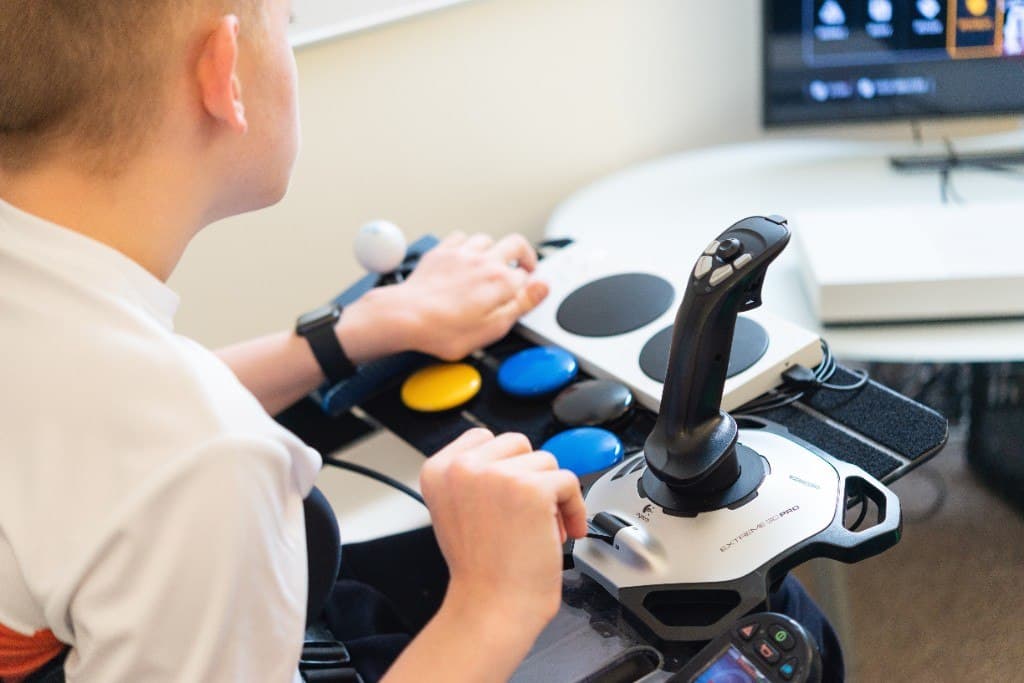
Over several years, we supported a young adult with an acquired brain injury through school, college, gaming and creative work. We let them try a trackpad, joystick, roller ball and other options, and they chose a standard mouse with a large-key keyboard, with a second set of controls for support staff. We remapped and replaced their adapted gaming controls as they wore. They now use their own set-up for college coursework and video editing towards a small business of their own, and they manage their technology themselves.
2. Managing more at home without support staff
An adult with sight and hearing loss lives at home with support workers. We researched and costed a new TV for them before it was bought, then set it up with accessibility features and voice routines, connected their hearing aids to their watch so they could answer calls, and linked a new washing machine to voice control with a simple start routine. We leave plain crib sheets so they can manage when their support workers aren't there.
3. Keeping up as the person grows
A young adult who uses a communication aid on a powered wheelchair has had our support for several years. We've refitted mounts as they grew and changed wheelchairs, measured up for a new vehicle and bed, and set their communication aid to control the TV. They now use it, together with voice control, to manage their TV, lights and blinds. We're now looking at backup buttons for times when the aid's battery runs low.
How to refer
- Get in touch. Call 01765 824971, email domore@accesstechnology.co.uk or use our contact form.
- Quote and CV. We send you our assessment quote and the CV of the consultant who will carry out the assessment.
- Referral form. Once you're happy to go ahead, you complete our referral form. Please send clinical details through the referral form, not the website contact form.
- Assessment. Your consultant contacts the family or the person to book an in-person visit, at home, school or both.
- Report. You receive a costed report to make your decision on.
- Your approval. Nothing is bought until you approve it. Then we buy, set up and train, and keep you updated on how it's working.
For what happens next, from the assessment to long-term support, see how it works.
Training for your team
We can also run a short session for your team on getting the most from assistive technology, or on digital wellbeing after brain injury. Get in touch to talk it through, or read about training for teams.
Call 01765 824971 or email domore@accesstechnology.co.uk.
Or send us a message using the contact form.